

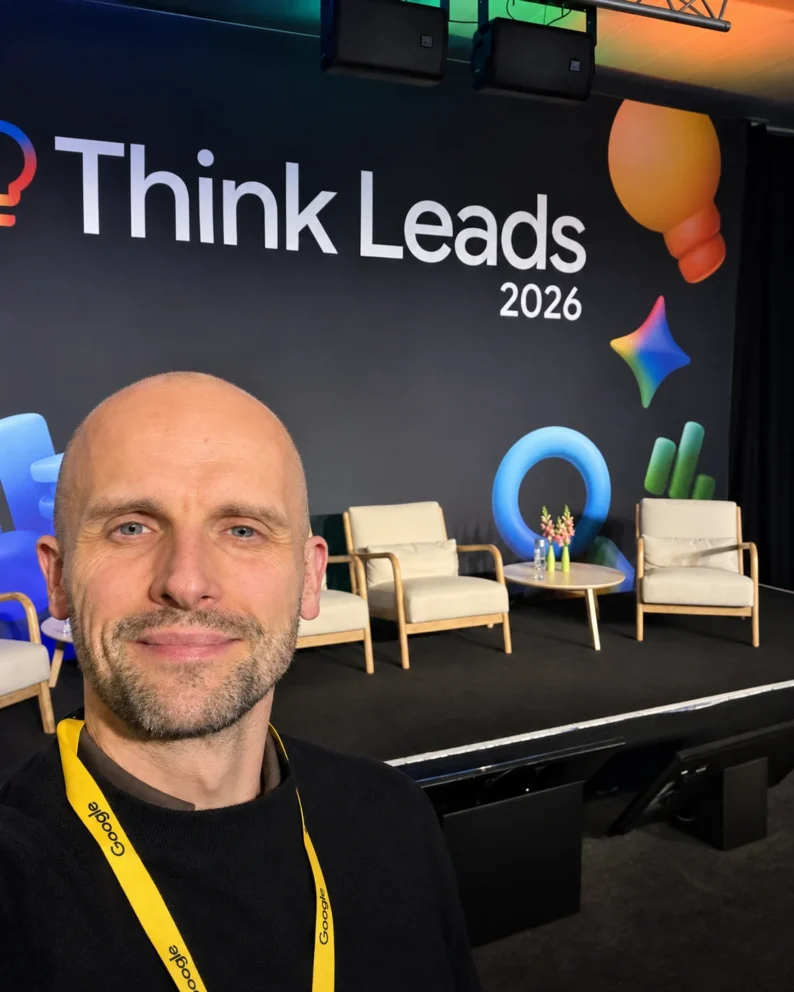
Google has just rounded off its annual Think Leads event in London and, as you’d expect, there were product developments aplenty and, yes, lots more AI and automation. But the ‘best data wins’ world Google presented left a clear gap for businesses that cannot provide the volume of data its approach depends on.
Think Leads is Google’s premier lead generation event, where advertisers and agencies are invited to hear its latest plans. MRS Digital joined to get a closer look at the latest developments and betas, and consider what they could mean for our clients’ strategies.
This year the party line was clear: Google is keeping up in the AI race, but if advertisers want to adapt to longer, more nuanced searches, they need to fully adopt Google’s automation products, with AI Max at the top of the pile. One of its global product leads stated, “AI Max and Performance Max are our bread and butter. They unlock billions of new queries you might not have reached.” And with everyone adopting the same tools, the competitive edge comes from getting your first-party data integration right.
Some of the advancements felt like much-needed evolution of the product suite, although there were still plenty of maybes and unanswered questions.
First party data has become the starting point
The language around first-party data has changed. Connecting your customer and sales data to Google Ads used to be presented by Google as ‘digital maturity’, something more sophisticated advertisers should work towards. At Think Leads, this had distinctly shifted to ‘data foundations’. Something advertisers are now expected to have in place.
It was refreshing to see Google tackle the industry’s complaints about declining lead quality head-on, especially around PMax, AI Max and generous keyword match types. Although, tactfully, Google framed this as balancing quality and volume.
What felt particularly telling was its candour about invalid leads:
“We have upgraded our automated backend defences, reducing advertiser exposure to invalid leads by an average of 30% in 2026 alone. […] Our automated systems have filtered 5 trillion invalid interactions this year.”
Beyond this, the answer to lead quality was overwhelmingly strong data foundations. The businesses represented on the customer panel spoke about aiming for 100% ‘data strength’ and investing in their data infrastructure.
We’ve long known that this is one of the most meaningful levers advertisers have to improve Smart Bidding. Feeding back qualified leads and sales gives automation something more useful to pursue than unqualified website form fills. But Google is now very much all-in on this approach, with little else being touted as a means of gaining an edge on the competition.
There was a useful reality check too. One panellist described a ‘crawl, walk, run’ approach, which Google reinforced. Getting these systems working takes time and stability. We see this at MRS. Changes to goals, data or bidding need time to show their effect, which limits how quickly you can change direction again.
For all the talk of automation, a strong foundation of traditional search targeting continues to work. It also generates the data that feeds Smart Bidding. More than ever, an account needs a steady pair of hands that knows when to intervene and when to leave it alone.
Google’s own commercial interests
It was stark how hard Google pushed its AI-powered campaigns as the way for advertisers to keep up with changing search behaviour.
Google has a clear commercial interest in that adoption. It needs to reassure advertisers that it can reach customers through the AI-generated answers in AI Overviews and the conversations in AI Mode. It also needs to earn more from those experiences.
Search advertising is still growing. But on Alphabet’s latest earnings call, Google acknowledged that AI Mode’s lower monetisation had contributed to slower Search revenue growth.
AI Max and PMax make it easier to bid in more places, more of the time. Google benefits when advertisers fund that extra coverage. The pitch is about adapting to consumer behaviour, but it is also about growing Google’s advertising revenue. We still need to establish whether that extra reach deserves our clients’ money.
The push to get there before the buying search
Google put a lot of emphasis on reaching people while they’re still working out what they need, rather than waiting for a search that signals they’re ready to enquire. Longer, conversational searches were central to this, with Google encouraging advertisers to consider how much of that earlier discovery their campaigns currently reach.
There was a similar emphasis on building awareness and familiarity through YouTube, Demand Gen and creator content. There was also plenty of encouragement to measure that contribution and build the confidence to invest beyond activity that generates an immediate enquiry, although there was less detail on how advertisers should actually go about it.
Creative was one of the few areas, beyond data, where Google gave advertisers clear ways to stand out. Its tools can help produce and adapt more assets, but volume alone won’t make them persuasive. If you’re about to spend a significant amount of money, hearing from someone who’s been through the same decision can be more reassuring than another sales pitch.
The developments that could make lead quality easier to manage
Encouragingly, many of Google’s product developments tackle the issue of lead quality head-on. These were the ones that stood out.
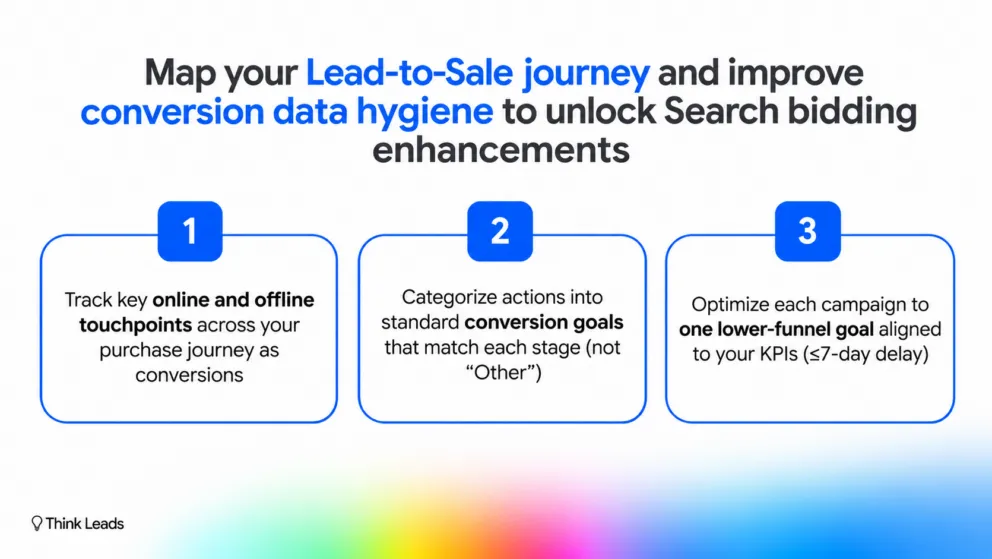
- Lead Journey Mapping. A tool for mapping the stages from first enquiry to sale within Google Ads, bringing together conversion actions, values and delays. It helps identify where leads drop out and where tracking is missing, so advertisers can improve the information feeding their bidding. Google described an ongoing pilot, with further rollout planned for Q4.
- Journey-Aware Bidding. Google reinforced the importance of sharing the full lead-to-sale journey so Search bidding can learn from earlier stages while still optimising towards a qualified enquiry or sale. You’re giving Google more information about what leads to a good customer, without asking it to maximise every form fill along the way.
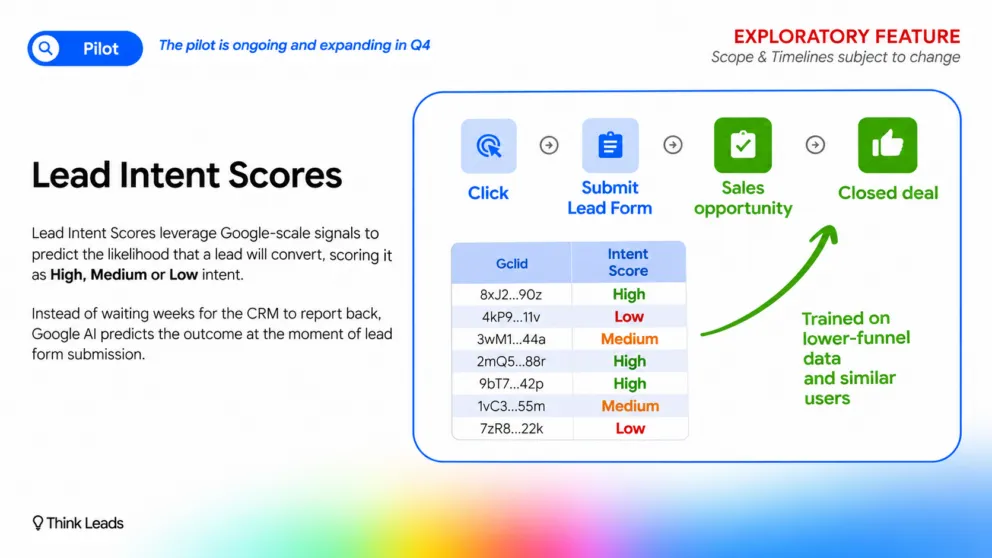
- Lead Intent Scores. Uses Google’s signals, trained on your imported conversion outcomes, to predict whether individual leads have high, medium or low intent. This could help sales teams prioritise follow-up before the eventual outcome is known. Google described a pilot expanding in Q4, with using the scores directly in bidding still being explored.
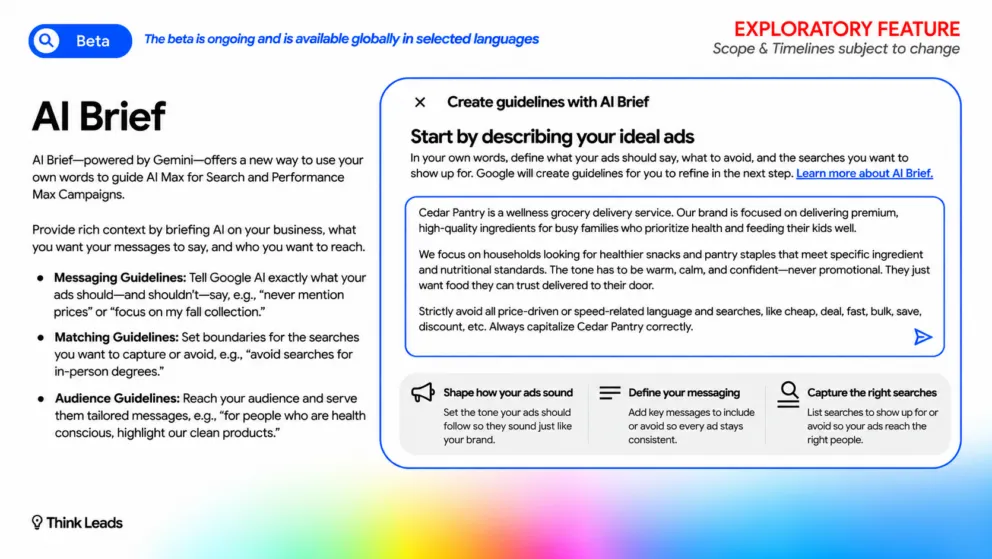
- AI Brief. Currently in beta in selected languages, this lets advertisers guide Google’s AI in ordinary language through three forms of input: Messaging Guidelines, Matching Guidelines and Audience Guidelines. These cover what ads should and shouldn’t say, which searches to pursue or avoid and who to reach with tailored messages.
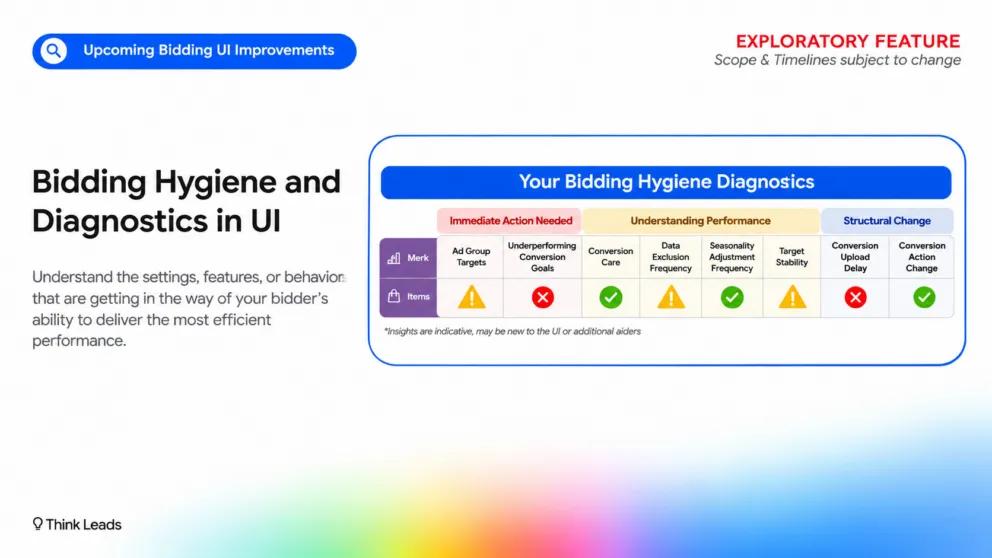
- Bidding Hygiene and Diagnostics in UI. Google previewed plans to highlight settings and data issues that could be holding bidding back, including conversion upload delays, misconfigured conversions and frequent target changes. The feature is exploratory, with internal pilots underway and an interface planned for 2027.
- Smart Bidding Exploration. Already available for eligible Search campaigns using target ROAS. Advertisers accept a lower effective return target to let bidding pursue more opportunities within their existing targeting. It’s designed for campaigns that aren’t limited by budget. If the budget does become a constraint, Google switches exploration off.
Google also previewed ways for customers to ask a business questions and make an enquiry without first visiting its website, through Business Agent for Leads and RCS for Business messaging. Alongside this, it outlined plans for AI Max to generate call, lead-form and message assets, with a pilot expected to start in early 2027.
This is encouraging. It feels much closer to the volume-versus-quality problem advertisers actually face. The test will be whether these tools improve the leads a business can use, rather than give it more ways to count activity.
Making AI usable in regulated industries
For advertisers in finance, insurance and other regulated industries, some of Google’s AI features create a fairly obvious problem. AI Max’s URL expansion and text customisation can automatically select landing pages and write new copy, introducing wording and pricing that the advertiser cannot simply allow to appear unchecked.
That is a reason these features remain unused in some accounts. Google appears to be addressing it head-on, with controls intended to make more of its automation usable.
- AI Brief. Google presented this as a way to constrain what its AI generates, using instructions about what ads should and shouldn’t say or show. For regulated advertisers, the ability to give directions such as “never mention prices” was particularly relevant.
- Disclaimers. Required wording that can appear alongside automatically generated creative. Search already supports text disclaimers with final URL expansion; Google discussed extending text disclaimers to PMax through a global beta expected later in Q4.
- Creative approval workflows. Google said creative generated in Asset Studio and PMax could be routed through advertisers’ own approval processes before going live.
AI Brief sounds great in principle, but I came away with very little assurance about how reliably it would follow those instructions, or how advertisers could check that it was doing so.
One advertiser asked exactly that in the Search breakout. Including a price in their ads triggered a need for further pricing disclosures, so how could they prevent Google generating prices and check all the ads it might produce?
Google pointed to AI Brief and the more specific controls within Text guidelines. These include term exclusions for blocking particular words or phrases and messaging restrictions for instructions such as “don’t generate assets with prices”.
But when it came to checking whether those controls were working, the answers felt elusive. Previews wouldn’t show every possible ad combination, and the ability to review and pause generated assets after they had served offered limited reassurance.
For a regulated advertiser, finding an unwanted claim after it has run may be too late. These are welcome controls, but it remains to be seen whether the visibility and assurance will go far enough for the businesses Google wants to bring on board.
The missing answer for advertisers with fewer conversions
The biggest gap for me was what advertisers should do when there simply aren’t many valuable conversions to feed into the Google machine.
A business can have good tracking, a properly connected CRM and a sound sales process. Yet if they sell to a small market or simply don’t have large budgets, better data infrastructure won’t suddenly provide a steady stream of qualified enquiries.
The event put considerable weight on learning from deeper outcomes. The Search panel addressed delays, suggesting an earlier qualification stage where the final sale takes too long, but it never really dealt head-on with low volume.
There’s an obvious advantage here for established businesses with years of customer data and enough scale to keep those deeper conversions coming. Niche providers and newcomers are at a distinct disadvantage, even if they get their tracking and integration right.
Journey-aware bidding may help make better use of earlier signals, but it doesn’t remove that imbalance. For now, Google’s answers for advertisers with low data volumes still feel incomplete. You’re left leaning on traditional approaches or trying to make automation work with less data than Google says it needs to learn effectively. Neither feels like a satisfactory answer to a problem this common.
SEO made an unexpected appearance
‘Good SEO is good GEO’ was a surprisingly prominent message, rolled out on more than one occasion. At an event centred on paid advertising, this felt a bit out of place.
Google was keen to stress that its AI experiences draw on its established Search ranking and quality systems. That also says something about where it believes its competitive advantage lies: years of understanding websites, useful content and credible sources. It may also point towards what we can expect from GEO, with greater emphasis on the signals that demonstrate a site’s true authority.
On the one hand, this is a helpful steer for those working in organic search, suggesting that established SEO practices still have a meaningful role in Google’s AI experiences. But it also felt like a PR message, reassuring the industry that SEO isn’t going anywhere and reminding us that Google still wants to be at the centre of that conversation.
Where the competitive edge still comes from
Data was repeatedly presented as the competitive advantage. Alongside creative, it received much more attention than the other decisions that help one advertiser outperform another.
Google’s message was to embrace its AI products, invest in your data foundations and reach audiences earlier in their discovery, using creative and authentic voices to build trust before they’re ready to enquire. But when everyone is being encouraged to adopt the same approach, the question is where you find your edge.
For MRS, that comes from getting the balance right: using automation to find worthwhile opportunities while retaining the targeting and messaging that still work, and keeping a firm grip on where performance is actually coming from. Google’s direction is clear. The judgement about how far and how quickly to follow it still matters.
Want more from Google’s AI tools without sacrificing lead quality?
Get in touch with MRS Digital to discuss how we can help you make Smart Bidding and AI Max work harder for your lead generation.