

Your next customer probably isn’t searching for your business. They may not even know what you sell exists.
They know their problem. They know the outcome they want. What they don’t know is which product, service or supplier gets them there, so they’re turning to AI to tell them.
In my view, that’s the biggest commercial opportunity in search right now. Most businesses are leaving it to chance. This is the AI gold rush. Businesses should be finding their opportunity now, not waiting for competitors to prove it works.
Buyers describe problems without knowing the solution
Take a complex B2B purchase. You sell specialist software that fixes a very specific operational problem. Your ideal customer lives with that problem every day, but they may not know your industry’s terminology, the category your product sits in or that a solution like yours exists.
So they open an AI tool and type:
“We run a business across several locations. Our finance system and CRM don’t talk to each other and the team spends hours reconciling data manually. We need better reporting without replacing either system. What are our options?”
That isn’t a keyword. It’s a brief, complete with context, constraints and a desired outcome. The answer might point them to an integration platform, a specialist consultancy or an approach they’d never considered. It could point them to you.
This is already how B2B buyers behave. G2’s 2026 Buyer Behavior Report, a survey of more than 1,000 software decision-makers, found that eight in ten had sourced software recommendations from AI tools such as ChatGPT or Google AI Mode in the past two years. G2’s earlier Answer Economy research found that half of buyers now start their research with AI more often than with Google.
The same research shows what that does to the shortlist. More than two-thirds of buyers said AI led them to choose a different vendor than they’d planned. A third bought from a vendor they’d never heard of before.
AI rarely closes the deal. But it increasingly decides who makes the shortlist. If you’re not on it, you don’t get the chance to compete.
What it looks like in practice
This isn’t just a software story. I recently spoke with a business that sells unusual, personalised gifts. Completely different market, same opportunity.
Someone can still Google “personalised birthday gifts”. But imagine the conversation starting like this instead:
“I need a present for my nan’s 80th. She loves anything to do with the family and I want something personal rather than another bunch of flowers. My budget is £75 and it needs to arrive within two weeks. What would you suggest?”
No product named. Just a person, an occasion, a budget and a deadline. That’s exactly what conversational shopping tools are built for. ChatGPT’s shopping research, for example, lets people describe what they need and refine suggestions until they find the right fit.
We ran this exact prompt through ChatGPT in November 2026. It suggested five ideas, from a family photo book to a framed family tree. For most of them it named specific UK suppliers: Photobox, Boots Photo, Argos and a seller on notonthehighstreet. It even checked delivery estimates against the deadline and put together a £71 budget. The gifting business I’d spoken to, a perfect fit for the brief, didn’t appear.
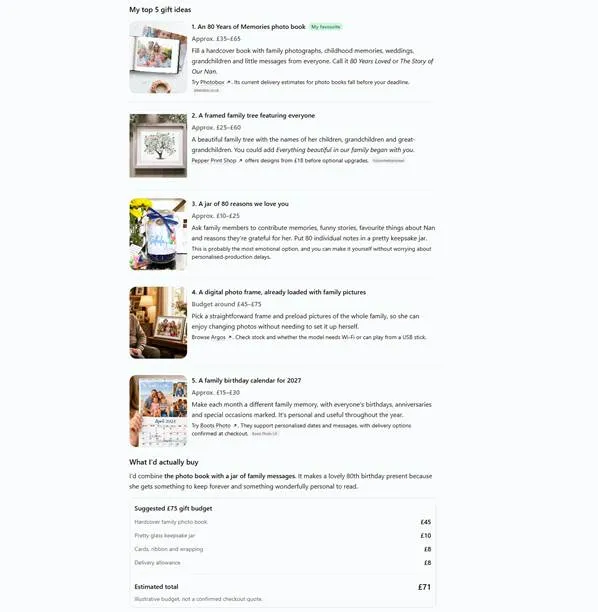
Look at what the AI tool had to work out before recommending anything. Is the product genuinely personal? Does it suit an 80th birthday? Does it cost under £75? Will it arrive in two weeks? It could only answer those questions for suppliers whose information it could find and trust. If those details aren’t published somewhere AI tools can read, a product can’t make the shortlist, however good it is.
So the commercial question is simple: when someone describes a situation your product is perfect for, do you show up? Having the right product and being discoverable are two very different things.
Good SEO is still the foundation
None of this means abandoning SEO. Similarweb’s data shows that 95% of ChatGPT users also used Google in May 2026, the same share as eight months earlier. People aren’t swapping one for the other. They’re using both. Google is blurring the line itself too. AI Overviews and AI Mode sit inside Google Search, Google’s own guidance says the same SEO fundamentals still apply.
So the real question isn’t SEO or AI search. It’s whether your plan accounts for both, with a deliberate approach to AI search visibility rather than an assumption that it’ll take care of itself. Call it AI SEO, GEO or AEO. I care far less about which acronym wins than whether the right customer can find you.
How to become part of the answer
There are good tools for tracking this. Platforms like Profound and Peec AI show how your brand appears in AI answers, how you compare with competitors and which sources are being cited. But tracking only tells you where you stand. Someone still has to decide what to change. Here’s where I’d start:
- Collect the questions buyers already ask. What does your sales team hear every week? What do prospects misunderstand and what stops them buying? Your Google Search Console queries help here too, because they show the longer, problem-led language buyers actually use. A software business might find that prospects keep asking whether it integrates with a specific finance system. That’s a question an AI tool will be asked as well.
- Audit your website against those questions. For each one, is there a clear, specific answer on a page that’s easy to find? If the integration answer is buried in a sales deck or a PDF, an AI tool can’t use it. Check that your site explains who your product is for, what it solves and where it isn’t the right fit. Comparisons, worked examples and evidence carry far more weight than claims about being innovative and customer-focused.
- Fix the foundations. Google’s guidance for its AI features still comes down to accessible, crawlable, well-linked and genuinely helpful content. There’s no special markup that guarantees inclusion. Check that your robots.txt isn’t blocking the crawlers AI search tools rely on, such as OpenAI’s search crawler. Keep key details like pricing, delivery times and specifications in the page text rather than locked in images.
- Look beyond your own site. Which publications, review platforms and specialist resources appear in AI answers in your market? G2 found that review sites have now overtaken AI tools as the biggest influence on which vendors make a buyer’s shortlist. Where is information about you missing, outdated or wrong? Reviews that mention specific use cases are especially valuable, because they match the way buyers describe their needs.
The goal isn’t to scatter your name across the internet. It’s to make your expertise easier to find, understand and verify. The right tools can support that work, but they can’t do it for you.
How we measure progress
At MRS Digital, we run traditional SEO and AI SEO together as one service. Our P.A.S.S® framework measures Presence, Accuracy, Salience and Sentiment: whether your brand or pruduct appears in relevant AI answers, whether what’s said about you is accurate, how prominently you’re presented and how positively you’re described.
Each measure catches a different problem. Presence covers the earlier, problem-led questions buyers ask before they know what kind of supplier they need, not just the ones that name your category. Accuracy covers the details AI repeats about you, from pricing to performance figures. If your own pages contradict each other, AI has to guess. Salience shows whether you’re named first or buried in a list. Sentiment compares how you’re described with how your competitors are.
To measure them, we put the questions your buyers actually ask into the AI tools they use, without naming any company. We ask them thousands of times, because AI answers vary from one ask to the next. Measuring all four gives us a clear basis for deciding what needs attention, rather than celebrating a one-off mention.
Appearing in an answer still isn’t the finish line. Visibility only matters if it brings you relevant buyers, better conversations and new revenue.
Why I’d move now
When I call this a gold rush, I don’t mean easy money or guaranteed visibility. I mean a window in which early movers build an advantage that’s hard for others to close.
We’ve seen it before with SEO. The businesses that built knowledge and capability while the channel was young didn’t spend the next decade catching up. AI search is at that stage now.
That doesn’t mean throwing your whole marketing budget at it. It means starting with clarity: the buyers you want to reach, the problems you solve for them and the gaps in how AI currently represents you.
Don’t leave your AI visibility to luck
Talk to MRS Digital about where you appear in AI answers and how to make sure the right buyers find you.