

‘AI Overviews SEO’ refers to the process of optimising content so Google’s AI‑generated summaries can accurately reference, cite, and surface your site within AI Overviews at the top of search results.
As AI Overviews continue to expand, optimising for them has rapidly become a core focus for many SEOs.
Google first introduced AI Overviews (AIOs) in the UK in April 2024, initially appearing for a small group of logged‑in users during the early rollout. However, it is estimated that approximately 60% of all queries now trigger an AI Overview.
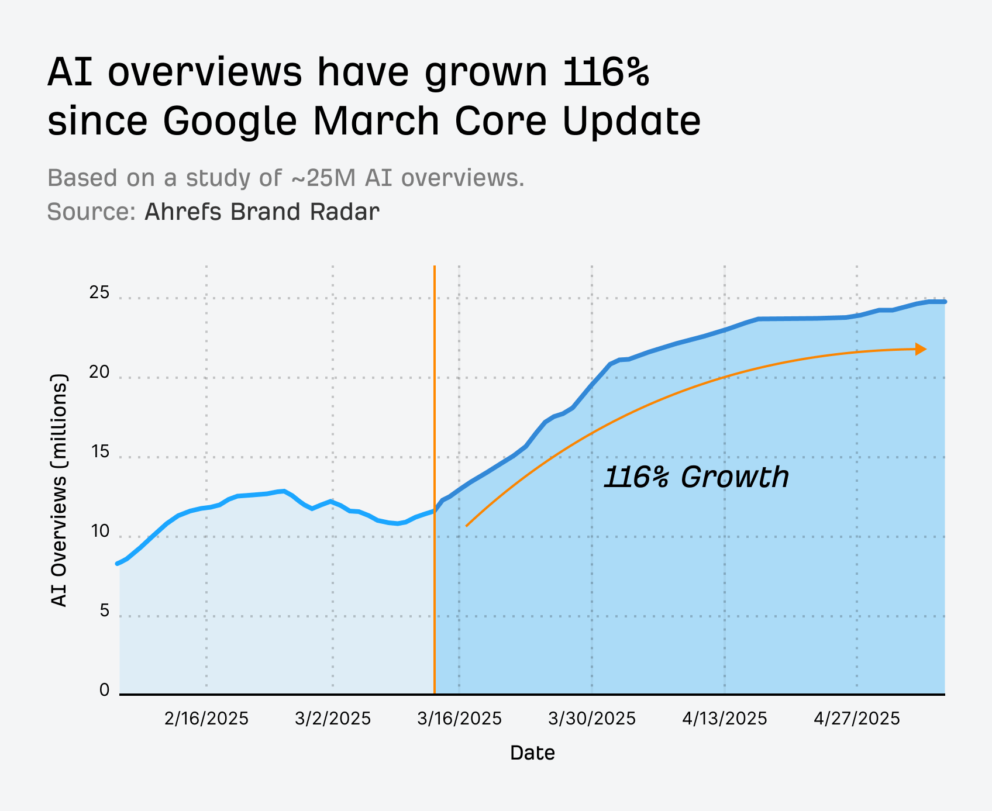
This is more than a mere algorithmic update, but a fundamental shift in how organic search operates. AI Overviews have changed how users interact with Google’s search results pages (SERPs), often providing a satisfactory answer without having to click through to a third-party website. This is referred to as a “zero-click search”.
But what exactly are AI Overviews, how do they work, and importantly for us, how can SEOs optimise content to consistently appear in them?
What are Google AI Overviews?
Firstly, let me explain exactly what a Google AI Overview is.
Google’s AI Overview is a short, AI‑generated summary that appears at the top of Google’s SERPs. It pulls key points from multiple trusted sources to provide a quick, easy‑to‑understand answer, along with links if you wish to explore further. It’s designed to save the user time by reducing the need to open several webpages.
How do AI Overviews work?
Google’s AI Overviews use a combination of large language models (LLMs) and traditional ranking systems to interpret your query, pull information from high quality indexed pages, and generate a fresh, concise summary that synthesises insights from multiple trusted sources.
They rely on Google’s search index, not real‑time browsing. In other words, AI Overviews don’t “scan the web live” – they draw from content already indexed and evaluated by Google.
Unlike traditional Featured Snippets, which quote a single page, AI Overviews create an original answer and may include links to the underlying content when helpful.
Not sure if your website is fully accessible to AI crawlers? Our MRS LLMs.txt Checker tool helps to ensure that your LLMs.txt content is structured and instantly understandable by AI crawlers – so your content gets the attention it deserves.
How do AI Overviews choose sources?
Google’s AI Overviews draw from the same foundations that have always powered search, which means strong historical SEO performance still plays a pivotal role in whether your content is selected.
AI Overviews use a multi‑stage process: they begin by retrieving a wide set of documents from Google’s index, then apply advanced re‑ranking systems to identify sources that demonstrate authority, clarity, and strong intent alignment.
Traditional signals like high‑quality backlinks, as well as citations, co‑citations, and brand mentions continue to help establish your site as a trusted authority.
E‑E‑A‑T, topical depth, and well‑structured content remain essential too, as Google favours pages that clearly and accurately answer the user’s query.
While AI Overviews can surface pages that don’t rank at the very top, research shows that most cited sources come from the top 100 organic results – meaning that doing SEO well historically will significantly increase your chances of appearing.

How to optimise for AI Overviews?
There is no doubt that AI Overviews have had a significant impact on search. Specifically, click-through rates (CTR), which according to a recent report by Ahrefs, have reduced by a massive 58%.
However, from our experience at MRS (and backed by Google), whilst organic clicks may be down, in many cases traffic quality can be dramatically improved. This is because the users that do click through are more qualified after having undertaken their research phase within the SERPs.
As SEOs, we need to stop simply reporting on click volume in 2026, as user behaviour has evolved.
#1 Use a clear & logical content structure
A clear and consistent content structure helps AI Overviews because LLMs understand and extract information more accurately when pages use logical headings, clean formatting, and well‑defined sections.
Structured content makes key facts, entities, and relationships easier for the model to identify, increasing the likelihood your page is selected during retrieval and re‑ranking. It also signals expertise and topical clarity to Google’s traditional ranking systems, which feed the pool of sources AI Overviews draws from.
A well‑organised page is simply more ‘visible’ to both search algorithms and LLMs, improving your chances of being cited. Importantly it also benefits the user experience too.
#2 Build E-E-A-T signals
E‑E‑A‑T signals still matter in AI Overviews because Google’s systems and the LLMs behind them prioritise sources that demonstrate clear expertise, real‑world experience, strong authority, and consistent trustworthiness.
Therefore, look to create user‑focused content written by credible authors with genuine expertise in your niche, supported by transparent, reliable sources. Pages that consistently demonstrate accuracy and authority are far more likely to be selected.
For example, if an author has two decades of experience in your industry, make this very clear to both search engines and the user. Validate exactly why their views on a given subject carry more weight than most; think experience earned, previous roles undertaken, accreditations acquired and other articles or white papers written.
Strong E‑E‑A‑T also helps your pages rank well organically, which increases their visibility to the models that generate AI Overviews. In practice, demonstrating expertise, citing evidence, and maintaining a trustworthy brand all raise the likelihood of being cited in AI‑generated summaries.
#3 Implement schema markup
Implementing schema markup properly improves AI Overview visibility by giving Google and its underlying language models a clearer, machine‑readable understanding of your content.
Structured data helps define entities, relationships, authorship, product details, FAQs, and key attributes in a format that LLMs can easily interpret with far greater precision than plain text alone. This reduces ambiguity, improves factual extraction and increases the likelihood that your page is selected.
Schema also reinforces E‑E‑A‑T signals by validating who wrote the content and when, what it covers, and why it’s trustworthy. When Google can reliably parse and verify your information, your chances of being cited in AI Overviews improve.
For example, use the ‘Author’ property to identify who created the content, as well as ‘sameAs’ to link that author to authoritative external profiles such as LinkedIn, industry publications, or professional websites. These connections strengthen E‑E‑A‑T by proving identity, qualifications, and reputation in a machine‑readable way.
{
“@context”: “https://schema.org”,
“@type”: “Article”,
“headline”: “Guide to AI Overviews”,
“author”: {
“@type”: “Person”,
“name”: “Jane Smith”,
“jobTitle”: “SEO Strategist”,
“sameAs”: [
“https://www.linkedin.com/in/jane-smith-seo/”,
“https://www.searchenginejournal.com/author/jane-smith/”,
“https://janesmithseo.com/about/”
]
}
}
#4 Employ a conversational writing style
A natural, conversational writing style improves your chances of appearing in AI Overviews because it aligns closely with how large language models interpret and summarise information.
LLMs understand clear, humanlike phrasing more reliably than dense, overly technical text, which makes your key points easier to extract and cite.
Conversational writing also mirrors the way users phrase queries, increasing intent alignment and topical relevance – two factors Google heavily weights when selecting sources.
When your content reads naturally, answers questions directly, and avoids unnecessary complexity, it becomes more accessible to both users and AI systems, strengthening its visibility in AI-generated summaries.
I recommend keeping one key message within each sentence where possible. Nesting multiple key messages within overly inflated sentences can make it much harder for systems to understand and extract your core points. There is also an additional UX benefit too, as this approach helps users scan content effectively.
What does this look like in practice?
❌ Non‑conversational example
“AI‑driven summarisation systems utilise multi‑stage retrieval pipelines to synthesise informationally relevant outputs, meaning content producers must ensure comprehensive optimisation across semantic, structural, and authority‑based signals to maximise inclusion potential.”
✅ Conversational, AI-friendly example
“When Google creates an AI Overview, it looks for clear, trustworthy information. If your content explains things simply, uses natural language, and answers questions directly, it’s much easier for the AI to understand and cite.”
#5 Keep your content fresh & up-to-date
Publishing fresh content which benefits the user can dramatically increase your chances of appearing in AI Overviews. This is because Google’s systems and the LLMs behind them prioritise information that is current, accurate, and reflective of the latest developments.
Updated pages are more likely to be re‑indexed, re‑ranked, and included in the retrieval pool the AI draws from. Freshness matters far more for fast‑changing topics – such as news, product updates, regulations, or trends – where outdated information quickly loses relevance.
For example, a query like “what percentage of searches show an AI Overview?”, users expect the most up‑to‑date data. Because AI Overviews appear in far more results than they used to, older content quickly becomes outdated and is far less likely to be cited.
Again utilise schema markup to inform AI systems and users of when your content was created and then modified.
#6 How topical authority strengthens AI Overview visibility
High topical authority increases your chances of appearing in AI Overviews because Google favours sources that demonstrate deep, consistent expertise across an entire subject area, not just a single orphaned standalone page.
Therefore, build strategic content clusters that cover a topic comprehensively. Then to boost topical relevance naturally interlink related content, and maintain clear thematic focus, positioning your domain as a genuine authority in that space.
Strong topical coverage also helps LLMs extract accurate, contextually rich information, making your pages more likely to be cited in AI-generated summaries.
But what does this look like in practice? Say you want to rank for the term “AI SEO”, and you create a thorough article to meet this intent. However, your content, although strong, consistently doesn’t appear in the AIO.
To increase your chances of positioning yourself as an authority in the increasingly competitive AI SEO space, it would be beneficial to cover the overarching topic much more comprehensively.
Think about creating supplementary, in‑depth content on semantically related topics such as “GEO vs SEO”, “ChatGPT”, “Perplexity”, “Entity SEO” and, of course, “AI Overviews”.
You can no longer earn organic visibility through keyword‑stuffed parent pages or basic link building, but by showing genuine depth across the broader topic.
AI Overviews summary
AI Overviews are Google’s AI‑generated summaries that now appear for an estimated 60% of searches, reshaping how users interact with results. They pull information from trusted, well‑indexed sources, meaning strong SEO fundamentals still determine whether a page is cited.
Their rise has significantly reduced click‑through rates – Ahrefs reports a 58% drop – because users often get the answer directly in the SERP. However, rest assured the traffic that does click through is typically more qualified, as users complete more of their research before visiting a site.
Therefore, as SEOs we need to adapt how we measure performance in 2026: success is no longer just about search volume, but about visibility within AI Overviews, content clarity, lead quality, E‑E‑A‑T, topical authority, and freshness.
The search landscape has changed, but meaningful opportunities remain for sites that optimise for how AI systems retrieve, understand, and cite information.
Those who adapt their SEO strategy faster and embrace the changes will likely thrive; see AI Overviews as an opportunity and not a threat.
MRS Digital is an award-winning SEO agency with a proven track record over more than 26 years. What’s more, we now offer a dedicated AI SEO service to help your business not simply navigate the changing face of the search world but thrive in it.
AI Overviews FAQs:
What searches trigger an AI Overview?
AI Overviews typically appear for broad, well known or informational queries where a quick summary is useful to users, such as brands, products, public figures, events, or general “how to” questions.
Although Google is generally more cautious to trigger overviews for YMYL related topics (e.g., health or finance) they may display them when high authority, trustworthy information is available.
What searches don’t trigger an AI Overview?
Google generally avoids showing AI Overviews for queries where an AI-generated answer may be unsafe or inappropriate. This includes sensitive financial decisions, complex legal guidance, and situations where personalised advice is required – such as “best mortgage providers” or “how to apply for a mortgage.”
How do AI Overviews differ from Featured Snippets?
AI Overviews synthesise the information themselves, while Featured Snippets pull the excerpt directly from the source page.
How do you turn off AI Overviews in Google Search?
Google doesn’t offer a setting to fully disable AI Overviews, but you can reduce how often they appear. The most effective method is switching to the Web filter at the top of the results page, which shows only traditional organic listings without an AI Overview.
You can also limit AI-generated summaries by using more specific or exact‑match queries (including quotation marks), which makes Google less likely to generate an overview.
To confirm these steps don’t remove AI Overviews entirely, but they significantly cut down how often they’re shown.
How should SEOs report on AI Overview (AIO) performance?
Reporting on AIO performance starts with tracking how often your content is cited in AI Overviews, as this is now a core visibility metric for SEOs. Because AI Overviews have contributed to a significant drop in CTR, reporting must shift from raw click volume to quality and presence. Useful metrics include:
- AIO citation frequency – how often your pages appear as referenced sources
- CTR quality – users who do click are more qualified after researching in‑SERP
- Topic‑level visibility – whether your wider content cluster is being surfaced
Paid SEO tools such as Ahrefs and SEMrush can help monitor ranking shifts, traffic quality, and SERP feature appearances, giving clearer insight into how AIOs affect performance.
How are AI Overviews formatted?
AI Overviews appear as a short, AI-generated summary at the top of the results page, followed by a small set of clickable source cards. The summary blends insights from multiple trusted pages, while the cards show the cited sites with a title, URL, and brief snippet.
The layout is intentionally concise and easy to scan, giving users a quick answer without opening multiple pages.
Where can users find source links in an AI Overview?
Source links appear directly beneath the AI-generated summary. Google displays them as small, clickable cards usually showing the page title, URL, and a short supporting snippet. These cards represent the trusted sources the AI drew from when generating the overview, giving users a quick way to explore the underlying information.